Self-Leadership · You Were Never Series
You Were Never Replaceable
May 25, 2026 · 8 minute read
You gave more than was asked. You stayed longer than was required. You covered things that were not yours to cover and carried weight that no one officially assigned you. And when the arrangement ended, or when someone newer arrived and you were moved aside, you were left with a question that has been running quietly ever since: did any of it matter?
It mattered. The fact that it ended does not mean you were replaceable. It means the arrangement was not built for what you were actually worth.
Why the Fear of Being Replaced Is Usually About Self-Worth
Replaceable means interchangeable. One unit swapped for another with no real loss to the system. That is not what happened to you. What you brought to that job, that relationship, that situation was specific to you. The combination of your experience, your judgment, your way of seeing problems was not something that gets pulled off a shelf and inserted.
What felt like being replaced was someone deciding the cost of keeping you was higher than the cost of losing what you specifically brought. That is a decision about their resources and priorities. It is not a verdict on your value. Achievement and worth get confused this same way in the other direction too. Those are different categories and conflating them is where most of the damage happens.
The person who took your role is not you. They are filling a position. The position and the person who occupied it are not the same thing. The organization moved on. That does not mean nothing was lost. It means they decided the loss was acceptable. That is their calculation to make. It is not a fact about who you are. Experiences that make you feel replaceable often damage both self-worth and self-value, because they convince you that someone else's decision reflects your actual importance.
"Dispensable is about fit. Replaceable is about worth. They are not the same word, and they are not the same verdict. One says the arrangement ended. The other says you did not matter. Only one of those is true."
Why Capable People Feel Not Good Enough After Being Replaced
When you are treated as though you are easily swapped out, it is hard not to internalize that as truth. Especially when it happens more than once. Especially when the people making that decision are ones you respected or needed approval from. Especially when no one came after them to say they were wrong. The fear of being replaced often turns into a deeper feeling of not good enough, even when the original event had very little to do with your actual abilities.
Take someone who trained their own replacement at a job they'd held for six years, then watched the company run exactly the same the week after they left. For a long time afterward, that fact got read as proof of their own unimportance, a kind of evidence that their specific contribution had never mattered. What actually happened was simpler and less personal: the role was designed to be transferable, which is a fact about the role, not about the years of judgment, relationships, and problem-solving that person brought to it that never showed up on an org chart. Their self worth took the hit. The role's design was never built to measure it in the first place.
But the behavior of people who treat others as interchangeable tells you about their operating system, not about the people they are processing. Organizations that consistently replace their best people with cheaper or more compliant versions are not running an accurate assessment of value. They are running a cost optimization. You happened to be in the calculation.
Feeling Disposable vs. Actually Being Replaceable
Dispensable means not essential in this particular arrangement at this particular time. Replaceable means no one else could do what you did. These are entirely different statements. You can be dispensable in a specific role and still be irreplaceable as a person in the right context. The role did not need you. That does not mean no role ever will. It does not even mean that role did not need you, only that the people running it decided the cost of keeping you was not justified by their priorities in that moment.
People who are genuinely irreplaceable get replaced too. Not because they were not irreplaceable but because the system that was using them could not sustain the cost or did not fully understand what it had. This happens constantly. It is not evidence about you. It is evidence about the system. The same logic applies to feeling disposable in relationships, not just at work. A partner who treats you as easily swapped out is revealing something about their own capacity, not delivering an accurate verdict on what you're worth. The same pattern appears in friendships, when someone drifts toward newer relationships and you interpret the distance as proof you never mattered.
The story worth examining
The story that you were replaceable is useful to the people and systems that replaced you. It makes what they did seem inevitable and accurate. It shifts the question from "was this the right decision" to "of course this was the right decision, anyone could see they were not irreplaceable." Accepting that story does their work for them. It turns their operational decision into a fact about your worth, and you carry it forward into every situation after that.
What a Pattern of Feeling Disposable Actually Reveals
If it has happened more than once, the useful question is not whether you were replaceable. The useful question is whether you have been consistently in arrangements that were not built for what you actually are. Whether the environments you have been in have valued what you bring. Whether you have been trying to prove indispensability to people who were never going to recognize it on the terms you were offering it.
The pattern is information. Not about your replaceability. About your placement. As described in some journeys take the long way home, the path that keeps returning you to the wrong arrangement is not evidence of your inadequacy. It is evidence that you have not yet found the arrangement that fits what you actually are. Those are very different problems.
Think about the arrangement where you felt most replaced or discarded. What specifically did you bring to that situation that the person or thing that replaced you cannot? The answer exists. It is worth knowing.
How to Rebuild Self Worth After Feeling Replaceable
You cannot build something real on the belief that you are replaceable. Not because the belief is too negative but because it is not accurate. What you can build on is the more honest version: you were in an arrangement that did not value what you brought, and that arrangement ended. The same self-editing instinct that shows up in meetings often shows up here too, quietly agreeing with the verdict instead of questioning it. That is the truth. It is harder than the story of replaceability in some ways because it requires you to keep looking for the right arrangement instead of settling for the explanation that you just are not worth keeping.
Stop measuring your worth by the decisions of people who were managing costs or protecting comfort or filling a temporary need. Their decisions about you were about their constraints. Real confidence is built the same way real self-worth is, from evidence you generate yourself, not from anyone else's calculation. You are not a commodity that was found lacking. You are a person who was in the wrong place for what you are. That is a fixable problem. The other one is not.
What is the specific thing you brought to the arrangement where you felt most replaced that the replacement genuinely cannot replicate? What would it mean to build toward a context where that thing is actually valued?
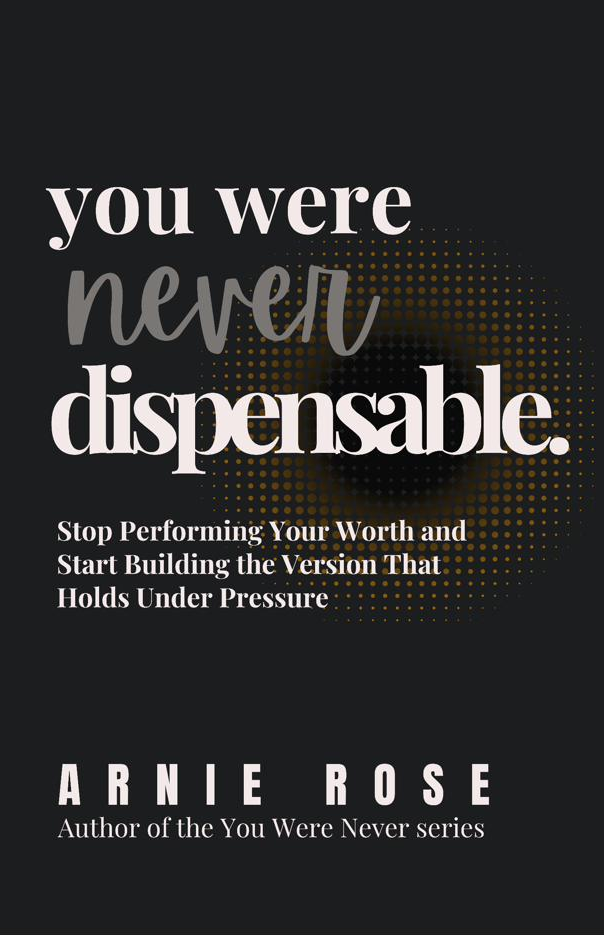
You Were Never Dispensable is about the years spent proving your worth to people who had already decided how much of it they needed. It is about recognizing the difference between being used and being valued.
Read You Were Never Dispensable on Amazon
Common Questions
Why do I feel like I'm not good enough after being replaced?
Being treated as interchangeable in one arrangement gets internalized as a fact about your overall worth, when it was actually a decision about someone else's costs and priorities, not an accurate measure of what you bring.
Why am I afraid of being replaced even when I'm doing well?
The fear of being replaced often comes from a past experience where you were treated as swappable, which gets generalized into an ongoing anxiety that has little to do with your current actual performance or value.
Does feeling disposable in a relationship mean something is wrong with me?
Not inherently. Feeling disposable usually reflects the arrangement you were in, not an accurate measurement of your worth. The pattern is information about fit, not a verdict on your value as a person.
How do I rebuild self worth after feeling replaceable?
Start by separating what happened from what it meant. Being dispensable in a specific arrangement is about fit. Being replaceable as a person is a different category entirely, and the two get confused more often than they should.
Beyond the Pages
Join the weekly newsletter. Early access on original writing: The Blind Spot Series, Ode to Home: Letters of the Living, and Beyond the Page.