You Were Never Series
Your Timeline Was Never Wrong
April 1, 2026 · 8 minute read
Your timeline was never wrong. You are not late. You are not behind. The specific timeline you have been measuring yourself against, the one that makes your progress feel insufficient and your choices feel like mistakes, was never yours to begin with.
It was borrowed. Absorbed without consent. Built from watching other people and deciding, somewhere along the way, that their pace was the correct one and that deviation from it was a form of failure.
That conclusion was never true. But it has been costing you anyway.
Why You Feel Behind in Life
You feel behind in life because you're measuring your timeline against someone else's, usually without realizing that's what you're doing. It happens automatically: a milestone passes for someone you know, and a conclusion arrives before you've had a chance to question it. You're not actually behind. You're comparing your full, unfiltered story to a single visible result in someone else's.
Your Timeline Was Never Wrong: Understanding the Race You Did Not Choose
Nobody hands you the timeline directly. You absorb it in pieces, from a parent's comment, a classmate's milestone, a number you saw somewhere and decided meant something. By the time you're racing it, you've forgotten you never agreed to run.
These messages are not neutral. They build a picture in which the only way to feel like you are succeeding is to be ahead, or at least visibly keeping up. Anything slower than the expected pace becomes evidence of something wrong, something missed, some turn you should have taken differently, some version of events where you made better choices and ended up further along by now.
The result is a persistent, quiet sense of being behind. Of having made wrong turns. Of being further from the destination than you should be by now.
But the destination was never yours. The route was never yours. The timeline you are measuring yourself against came from someone else's story, filtered through a cultural lens that assumes one kind of life is the right kind, and that everything else is a deviation from it.
Why Comparing Yourself to a Timeline Feels So Convincing
Part of why this is so hard to shake is that the comparison never feels like a comparison. It feels like an objective fact about where you should be. A milestone passes for someone you know, and the conclusion arrives before you have a chance to question it: you are behind.
But you only see the milestone. You do not see the years that led to it, the support that made it possible, the version of events that never got mentioned. You are comparing your complete, unfiltered story, every delay and detour included, to someone else's single visible result. That comparison was never fair, no matter how convincing it felt in the moment.
Social media accelerates this. A feed compresses years of someone else's life into a few seconds of highlights, with none of the struggle or the waiting shown. The amount of comparison available at any given moment is higher than at any point in human history, which means the feeling of being behind now arrives faster and more often than it used to, not because more people are actually falling behind, but because there is simply more to compare against.
Read The Blind Spot on Substack
Essays on identity, change, and the decisions that quietly shape a life.
Subscribe on Substack
What It Actually Means That Your Timeline Was Never Wrong
It does not mean that you have been making all the right choices. You may have made some wrong choices. That is not the point.
It means that the pace at which your life has moved, and the sequence of events that brought you to this exact point, was never wrong simply because it did not match someone else's pace or someone else's sequence. It was yours. It was shaped by your starting point, your circumstances, your choices, and by things that happened to you that were completely outside your control and yours alone to carry the weight of.
It was just never theirs to begin with.
Why Late Starts Often Feel Like Failure (And Usually Aren't)
A late start carries a specific kind of shame that an early start never has to answer for. Nobody asks the person who started young to justify their timing. The person who starts later gets asked constantly, sometimes by other people, more often by their own internal narrator, why it took so long.
But a later start often comes with information an early start never had access to. Years spent doing something else were not wasted years. They were data. They narrowed down what actually mattered before the real commitment began, which is a kind of efficiency that looks like delay from the outside but functions more like preparation from the inside.
Signs You're Measuring Yourself Against Someone Else's Timeline
- You feel a specific kind of dread around birthdays or anniversaries, tied to where you "should" be by now rather than how the year actually went.
- You can name the exact person or group whose pace you're quietly comparing yourself to, even if you've never said it out loud.
- Good news about someone else's milestone produces an immediate, involuntary drop in your own mood.
- You describe your own pace using words like "behind" or "late" before you describe what you've actually built.
If two or more of these sound familiar, the issue is probably not your actual life. It's the borrowed schedule running quietly underneath it.
The Timeline Was Always a Story, Not a Fact
It helps to remember that a timeline is not a law of physics. It is a story, built from what your family valued, what your culture rewarded, what your peers appeared to be doing, and what you decided those things meant about you. None of that is fixed. Stories can be examined. What gets examined can be changed.
This distinction matters because timeline anxiety almost always feels like it is responding to something real and true. It is not. It is responding to a story that was handed to you, often before you were old enough to ask whether it actually applied to your life. Six questions worth asking yourself can help separate which parts of your current picture of yourself are actually yours, and which were simply absorbed early and never looked at again.
The same goes for comparison itself. The post on comparing yourself to others explains why this specific kind of measurement feels so automatic and so convincing, even when it's built on almost nothing solid.
What Actually Matters More Than Timing
Speed was never the part of your life that other people remember or respond to. What tends to matter, both to you and to the people around you, is whether what you built holds up, whether it was honest, whether it actually fit your life rather than someone else's script for it.
A slower path that ends somewhere true tends to outlast a faster path that ends somewhere borrowed. This is not a consolation prize for people who started late. It is simply a more accurate way to measure what actually counts. Growing slowly is not the same as growing wrong, and the pressure to confuse the two is exactly what keeps the borrowed timeline running in the background long after it stopped making sense.
This is also where the comparison to other timelines breaks down completely. Two lives that look similar on paper can be running on completely different fuel, one built from genuine want, one built from obligation or fear of falling behind. Not everyone blooms in the same season, and the bloom that takes longer is not a lesser one for having taken its time.
How to Stop Measuring Yourself Against a Timeline That Was Never Yours
- Ask where the specific timeline you are racing actually came from. Name it. Is it cultural? Is it a comparison with a specific person? Is it an expectation you absorbed from your family or your industry?
- Separate the genuine constraints in your life, the things that actually require timing, from the imagined ones.
- Read You Are Not Running Out of Time for more on where the panic about time actually comes from.
- Read Your Life Is Not a Competition for more on the leaderboard that was never real.
- Read Growth Is Not Always Visible for why the work that matters most often produces no visible proof while it's happening.
- Read Becoming Takes Longer Than People Admit for why the timeline nobody talks about honestly is usually longer than what gets shared.
- Read You Are Still Becoming for what it means to stop treating growth as something with a deadline.
You are not behind. You are measuring yourself against a clock that was never set for your life. Your timeline was never wrong. It was just never theirs.
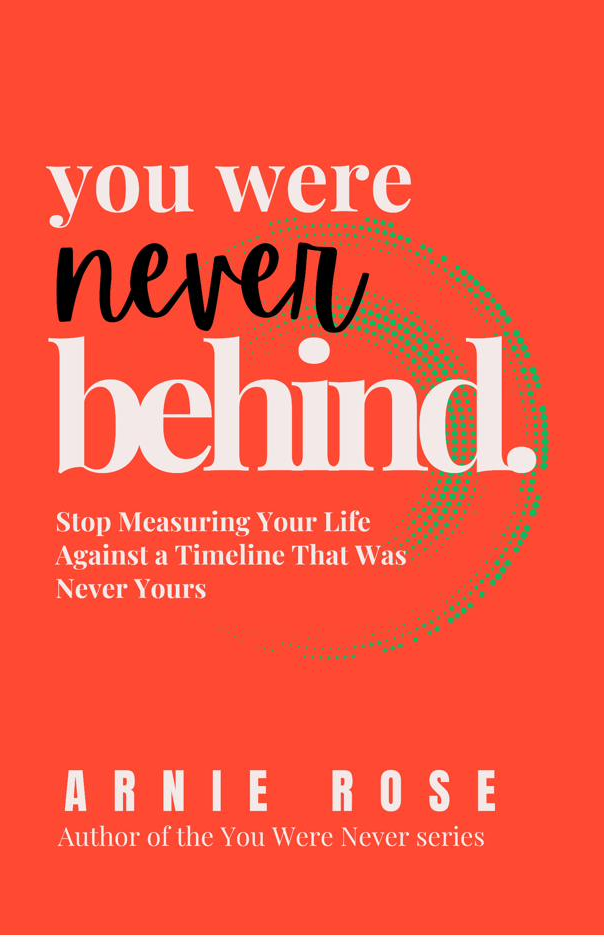
The book You Were Never Behind builds this argument in full. If the feeling of being behind is something you carry daily, in your work, in your relationships, in your sense of who you are supposed to be by now, this is the book to read. It is not about convincing you to be satisfied with where you are. It is about showing you why the measurement you have been using was wrong from the beginning.
Common Questions
Am I behind in life?
Probably not, even though it feels that way. The sense of being behind almost always comes from comparing your specific path to a generic timeline that was never built for your actual circumstances.
Why do I feel behind everyone else my age?
You're seeing other people's milestones without seeing the years, support, and setbacks that came before them. The comparison feels accurate in the moment. It usually isn't.
Is there a right timeline for success?
No single timeline applies to everyone. What looks like the right pace is usually just the most visible one, shaped by whichever examples happened to be in front of you.
How do I stop comparing my progress to other people?
Start by naming exactly whose timeline you're measuring against, since it's rarely an abstract standard and usually a specific person or group. Naming it makes the comparison easier to question.
Beyond the Pages
Join the weekly newsletter. Early access on original writing: The Blind Spot Series, Ode to Home: Letters of the Living, and Beyond the Page.