
The version of you that fits everywhere without friction is not the real one. It is the managed one. And the people around you can feel the difference, even when they cannot name it. There is a quality to a conversation with someone who is fully present versus someone who is carefully managing what they bring into the room. You have been in both kinds. You know which one you prefer.
Shrinking is not the same as being polite. It is not the same as being considerate or reading the room well. Shrinking is when you remove the parts of yourself that might make someone uncomfortable, not because those parts are wrong, but because you have learned that taking up full space comes with a cost you would rather not pay.
Why People Learn to Shrink Themselves
You did not decide to start shrinking. It happened gradually, in response to specific experiences that taught you it was safer to be smaller. A time you took up space and got punished for it. A relationship where your needs were treated as inconvenient. A group where your honesty made people uncomfortable. You learned to preemptively adjust yourself before anyone asked you to. That habit was a reasonable response to a real situation. The situation has probably changed. The habit has not.
So you adjusted. You got smaller. You got quieter. You got better at reading what people wanted from you and giving them that version instead of your actual one. This is the early shape of what eventually gets called people pleasing: not a personality trait, but a learned response to a specific cost that once felt too risky to pay. And somewhere along the way you started calling it maturity. You told yourself you had learned how the world works. What you had actually learned was how to make yourself easier to be around at the cost of being less genuinely present.
The adjustment made sense at the time. The problem is you kept making it long after the original situation changed. As explored in healing is not proof that you failed, the ways we protect ourselves in one season do not automatically update when the season changes. You built the habit for a specific kind of room. You kept it for every room after that.
"Acceptance you had to earn by shrinking is not acceptance. It is tolerance of the version of you that is easiest to manage. That is not the same thing and it does not feel the same either."
The Hidden Cost of Shrinking Yourself
When you shrink consistently, people do not get to know you. They get to know the edited version. And relationships built on the edited version have a ceiling. There is a point of closeness you cannot get past because the person on the other side is not fully there. You feel it as a kind of distance that exists even in relationships that look close from the outside. Everything is fine. Nothing is quite real.
You also lose access to your own instincts over time. When you spend enough time second-guessing what you bring into a room, you start to lose access to it. The opinion forms more slowly. The confidence to act on it fades. The habit of deferring your full presence becomes a habit of distrusting it. What started as a social strategy becomes a way of relating to yourself, and self acceptance becomes harder to reach the longer that strategy runs uninterrupted.
And there is the energy cost. Shrinking is exhausting. Managing the presentation of yourself requires a constant background process running in every social situation. You come home from interactions that should have been energizing and feel drained instead. That is not introversion. That is the cost of performing yourself instead of being yourself.
The part that is hard to say
Some of the rooms you are shrinking for do not actually require it. You have been performing smallness in situations where the threat you are protecting yourself from is no longer real. The people in front of you now are not the people who taught you to shrink. You are applying an old lesson to a new room and calling it reading the situation. It is not. It is carrying a wound into a space that did not create it and letting it run the interaction anyway.
5 Signs You're Shrinking Yourself to Fit In
- You add a pre-apology before sharing an opinion, even when the opinion isn't controversial.
- You laugh at things that weren't funny because the temperature of the room felt safer that way.
- You come home from social situations that should feel energizing and feel drained instead.
- You phrase direct statements as questions, softening them before anyone has a chance to react.
- You notice your opinions forming more slowly than they used to, because you've practiced second-guessing them for so long.
None of these require a dramatic situation to show up. Most of them happen in completely ordinary rooms, with people who were never the ones who taught you to shrink in the first place. Real confidence runs on the opposite pattern, and rebuilding it usually starts in exactly these small, ordinary moments.
Taking Up Space Is Not Aggression
There is a long-standing confusion between taking up space and being aggressive, demanding, or difficult. They are not the same thing, and the confusion is not accidental. Saying what you actually think, needing what you actually need, and being present without apology can all get labeled as difficult by people who benefit from you staying small. The label is not a diagnosis. It is a preference someone else has about how you behave.
None of that is aggression. Aggression is when you try to take up more space than the situation calls for at someone else's expense. Taking up the space that is genuinely yours is not aggression. It is presence. And presence is something the people worth being around can handle without needing you to manage it for them.
Why Real Belonging Does Not Require People Pleasing
Real belonging does not require a performance. It does not ask you to be smaller or quieter or different enough to be tolerated by the people around you. When belonging consistently requires you to change what you actually think or hide what you actually feel in order to stay in the room, what you have found is not belonging. It is conditional acceptance with a membership fee that gets charged in silence and discomfort every single time you are in that space.
The rooms that only work because you have made yourself smaller for them are not places where you belong. They are places where your edited version is tolerated. That is worth knowing. Waiting for those rooms to grant you permission to be fully present is not a reason to leave immediately or to start performing loudly in the other direction. It is a reason to build self acceptance somewhere more honest, and to stop measuring your belonging by whether you are accepted in rooms that were never built for what you actually are.
Think about the last time you felt genuinely comfortable in a room without adjusting yourself for it. What was different about that situation? And what does that tell you about what you have been settling for in the rooms where you consistently shrink?
How to Stop Shrinking Yourself in Everyday Life
You do not fix this by forcing full presence everywhere at once. You start with the safest room available to you right now. One conversation where you do not edit. One message where you leave the direct sentence in instead of softening it. One moment where you do not laugh at the thing that was not funny. Each of these is being yourself in a small, low-stakes way, which is exactly the scale the practice needs to start at.
Notice what happens. The room does not collapse. The relationship does not end. The person on the other side adjusts to the version of you that is actually there, and in many cases, the interaction improves. You have one piece of evidence. The next instance gets a little easier to risk. The habit of shrinking was built through repetition. It comes undone the same way.
The space you were afraid to take up was available to you the whole time. You just kept deciding it was not safe before you checked whether that was still true.
In which room or relationship have you been shrinking the longest? And what specifically would you say or do if you decided to stop shrinking in that one place?
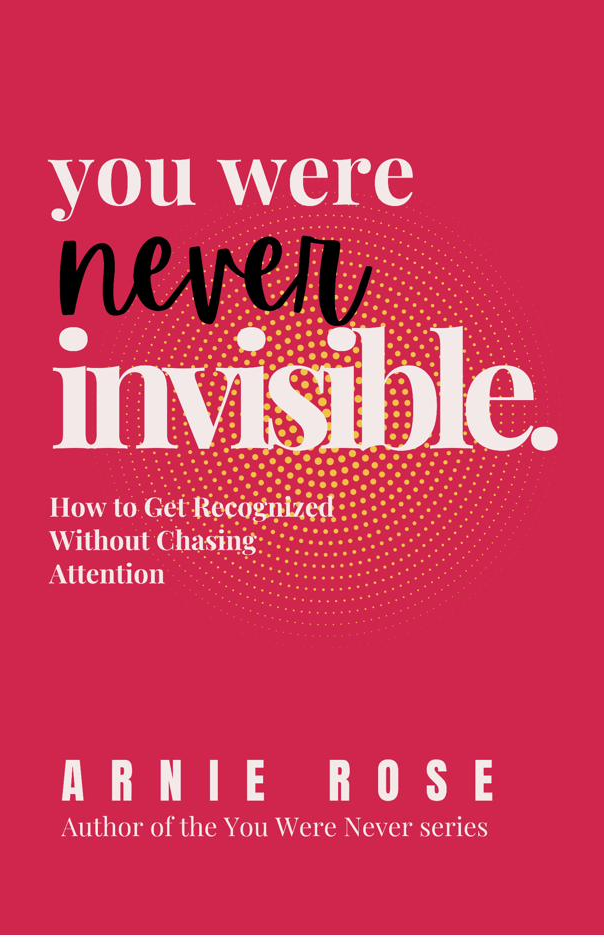
You Were Never Invisible is about the years spent making yourself easy to overlook because being seen felt more dangerous than being missed. If this post landed, that book goes deeper into exactly what has been happening and why it started.
Read You Were Never Invisible on Amazon